Loading
Loading content, please wait.Loading
Loading content, please wait.Cleaned, brightened, and stained to stand up to river humidity, lake-effect winters, and full summer sun.
or call us directly at (269) 437-0891
Three Rivers sits where the St. Joseph, Rocky, and Portage rivers meet, with Corey Lake, Clear Lake, and a dozen smaller lakes minutes away. That's exactly why people live here — and exactly why decks in this area age faster than the stain can label promises. Waterfront and low-lying decks spend spring mornings under fog, hold moisture in shaded boards long after a rain, and then bake under open summer sun. Moisture plus UV is the combination that turns wood gray, lifts the grain, and peels a finish that was applied over damp boards.
Winter does the rest. Snow sits on horizontal deck boards for weeks at a time, and every thaw sends meltwater into the end grain and every crack in the old finish. A few freeze-thaw cycles later, the surface checks and splinters. This is why deck staining in Southwest Michigan is mostly a preparation job: the wood has to be cleaned of gray, UV-damaged fibers and mildew, brightened to reopen the grain, and — most importantly — dry enough to actually absorb stain before anything gets applied.
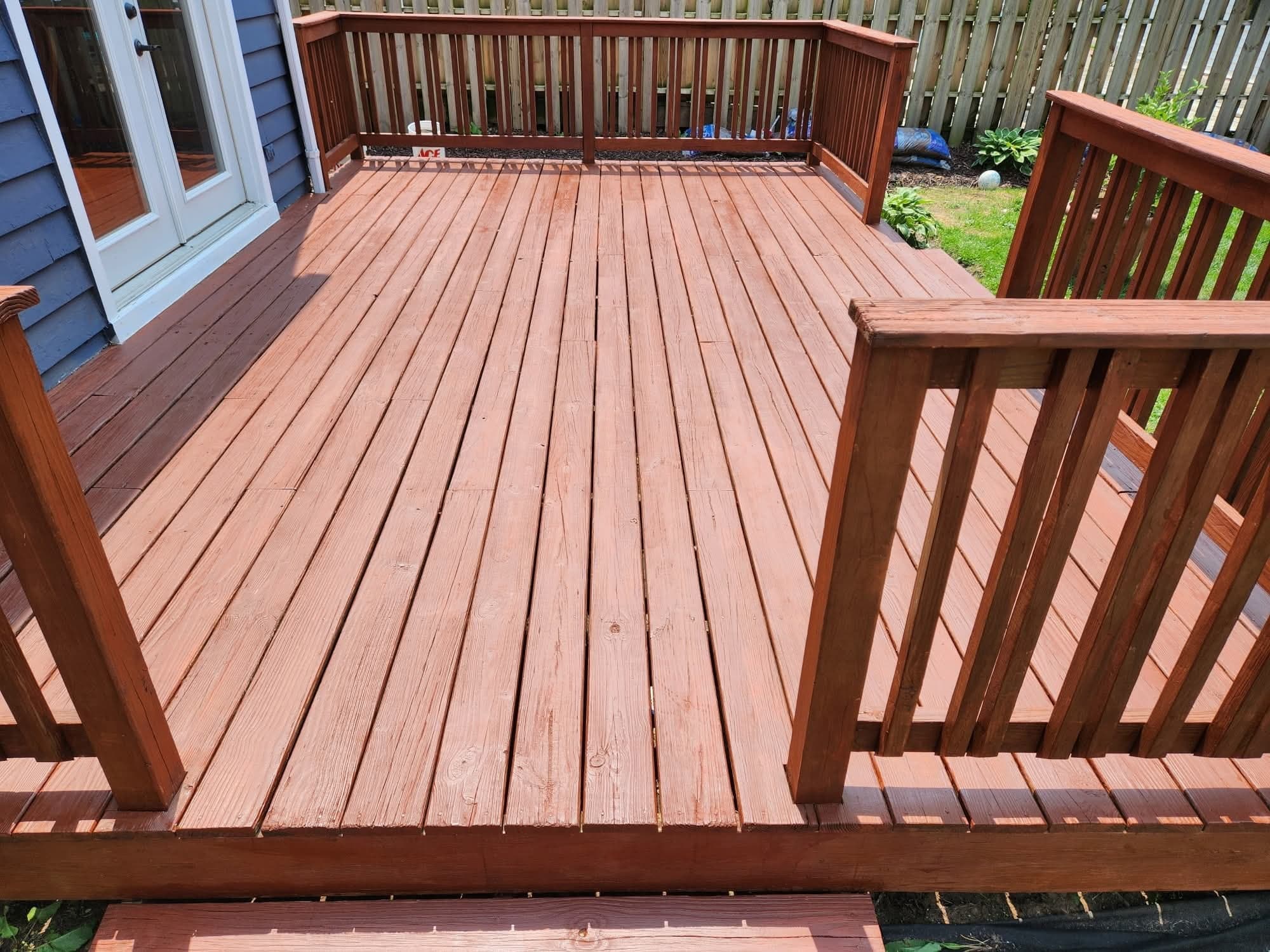
Our process in Three Rivers is the same one we use across Southwest Michigan: wash and strip as needed, brighten, let the wood dry to the right moisture level, then apply a penetrating stain matched to the deck's condition and exposure. Transparent and semi-transparent stains show the grain and are the right call for newer cedar and pressure-treated wood; solid stains are the honest answer for older decks with too much history to hide. We'll tell you which one your deck actually needs when we walk it.
We quote deck work as a fixed number with the scope in writing — cleaning, repairs, and staining spelled out line by line. If boards or railings need replacing before stain makes sense, we'll say so up front rather than staining over a problem.
The written quote we send spells out the exact scope. Here's the baseline of what comes with every job.
Timelines below are rough estimates. Actual schedules depend on prep, weather, the size of your job, and our current crew workload. The written quote we send locks in real dates.
Late spring through early fall, in a stretch with no rain for at least 24–48 hours after application and moderate temperatures. Near the rivers and lakes the bigger constraint is usually the wood itself: it needs several dry days beforehand so the boards are dry enough to absorb stain. We check moisture before we start rather than going by the calendar.
Usually, yes — it just needs more patience. Shaded, low-airflow decks near water hold moisture longer, so we schedule the wash earlier, allow extra drying days, and verify the boards are dry before staining. Skipping that step is why waterfront decks peel; doing it right is most of the job.
Semi-transparent shows the wood grain and works well on newer or well-maintained decks, but it needs recoating more often. Solid stain covers like paint, hides patched and weathered boards, and lasts longer between recoats — the practical choice for older decks. We'll recommend one based on your deck's actual condition, not upsell the more expensive option.
On horizontal surfaces in this climate, expect 2–4 years from a penetrating stain before high-wear areas want a maintenance coat; verticals like railings and privacy walls last considerably longer. Sun exposure, tree cover, and how much snow sits on the deck all move that number. A quick wash-and-recoat on schedule is far cheaper than a strip-and-restart after the finish fails.
Learn more about our work and the areas we serve:
Free estimates. No pressure. Usually back within 24 hours, often same day.